Thursday, December 3, 2009

Silver and Gold Christmas Wishes


As usual, I don't have much of a Christmas list this year. My wishes tend to run toward the practical: I'd really like to get my car detailed, my kitchen needs painting, and my master bathroom needs a fairy godmother to wave her wand on it because I continue to drag my heels on that whole mess. I could definitely use the services of a personal shopper to update my wardrobe. But those are all things that can't be wrapped up in a box. As material goods go, I'm lucky enough to have more than I really need and most of what I want. But it's that time of year, when my mailbox is stuffed with catalogs full of pretty things and I couldn't help but notice a few. Among the things that have caught my eye, a pattern emerged. Silver and gold. Grey and taupe. Call me predictable, but I'm always drawn to these combinations when it comes to clothing and jewelry.

First up, who can resist a snow globe? Especially one as simple and perfect as this one, above. Trouble is, it's the watch inside the jar that's for sale. A one-of-a-kind mix of vintage faces linked together. Very intriguing but if it doesn't come with the snowman, maybe I don't want it after all. (anthropologie)


These I'll take just as they come. Sparkly daisy ear studs. Silver and gold. Better together.(anthropologie)


Less sparkly but just as much fun. A taupey-grey cardigan with appliqued leaves and flowers. Can I pull this off? I suppose I'd have to try it on to know for sure. But I do love it. (anthropolgie)


I also love the look of mixed up charms on a great chain. My favorite kind of necklace from the source of some of my most-worn pieces. (sundance)


Speaking of chains, silver and gold on pleated chocolate leather. The latest discovery in my ongoing search for the new perfect handbag. What do you think? Are chains over? I don't really care about trends but I don't want to look ridiculous either. (nordstrom)

And, finally, here's something I want that, sadly, can't be bought. . .

It's an image I saved from an Anthropologie email ad promoting their Christmas ornaments. I can't tell whether it's an actual shadow box put together to showcase birdies or if it's totally photoshopped. Either way, it's charming. Greys and golds and taupes and silvers plus a bit of color for fun. I just want to look and look and look at it. It makes me happy. And isn't that what the best gifts are meant to do?


Click on the images to go to their source. Except the shadow box. It's mine, all mine.

Monday, November 30, 2009

Apparently, chrysanthemums don't have anything to do with Christmas


Nope. There is no connection whatsoever between these two similar sounding words, as much as I tried to find one to make this post more "seasonally appropriate". The word chrysanthemum was created by the Swedish botanist Carl Linnaeus when the flower was first brought to Europe in the 17th century. He simply combined the Greek words chrysous, "golden" (the colour of the original flowers), and -anthemon, meaning "flower". Nothing to do with Christmas at all. But that's okay, because it is still November after all. For a few more hours anyway. And if you were born in the month of November, your birth flower is the chrysanthemum. Which is why we're talking about them in the first place. . .

Blooming in late summer and fall, these flowers, also commonly referred to as "mums", are native to Asia and Europe. Chrysanthemums were important to the ancient civilizations of both China and Japan and many of the attributes and symbolism attached to them remain with us today.
Confucius suggested they be used as an object of meditation, perhaps because of the perfect arrangement and repetition of their many petals. The Chinese also felt that the chrysanthemum promoted longevity and made wines and medicine from infusions of its leaves and petals. The dew collected from mums was supposed to be particularly effective in increasing the lifespan of those who ingested it. Additionally, the chrysanthemum flower is actually a powerful antiseptic and antibiotic and is used in traditional Chinese medicine to treat high blood pressure and angina. As a result of these medicinal applications, the mum was also considered one of the four noble plants in China along with bamboo, plum, and orchid.


The Japanese were first introduced to the chrysanthemum in 400 A.D. by Zen Buddhist monks. It became a symbol of the Mikado and was displayed as a sixteen petaled mum made to look like the Rising Sun. To this day, the Japanese consider the orderly unfolding of a chrysanthemum's petals to represent perfection.
It is the national flower of Japan and symbolizes the Japanese Emperor. In many parts of Asia, the flower's petals are boiled in order to make a sweet drink known as chrysanthemum tea. It is believed that this tea has many medicinal uses including curing influenza.


In many European countries, Italy among them, the chrysanthemum is a symbol of death and is used for funerals or on graves. However, because the chrysanthemum resembles its close cousin the mugwort weed, which is often called the wild chrysanthemum, many florists do not like to use the flower in arrangements. The opposite seems to be true in America where the chrysanthemum is seen more often as positive and cheerful. They certainly are abundant in florist shops and garden centers this time of year, and undoubtedly graced many a Thanksgiving table and made appearances as innumerable hostess gifts on that day.


Traditional books about the language of flowers include the following meanings for the mum: cheerfulness, you're a wonderful friend, rest; loveliness, abundance, wealth and longevity. At celebrations, according to the website teleflora.com, a single petal of this November birth flower placed at the bottom of a wine glass will encourage a long and healthy life.

Now, back to the Christmas connection I tried so hard to find. A wreath! One lonely wreath decorated with sprigs of berries and dried chrysanthemum blossoms and tied up with a chartreuse satin ribbon. A rare find and an unconventional combination of colors and materials that finds November's birth flower on a symbol of a December holiday more commonly covered in poinsettias and pine cones. What do you think? Is a chrysanthemum wreath for you?

Image sources top to bottom: chinese brush art painting at Rene Moase Art, painting by Pierre Auguste Renoir, photo by keylimepie, painting by Marianne North at kew.org, photo by Joe Sala, painting by Vincent VanGogh, wreath photo at goodhousekeeping.com

Saturday, November 21, 2009

Mood Boards for Fun and Profit: Sarah's Challenge and Susan's Contest


I interrupt my own series on decorating with collections to bring you news of two fun blogger diversions...

Having taken over the helm of Mood Board Monday with PK's blessing and encouragement, Sarah at Pewter+Sage recently announced the next challenge. All set to host on her beautiful blog, Sarah's inspiration pieces are Christmas pillows, one of which you see above. Take a look at this post, choose a pillow to build a room around and put a board together. Sarah's just-for-fun MckLinky party is scheduled for Monday, December 7th.


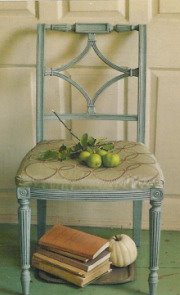
Another mood board challenge is being hosted by Susan at Love Where You Live. Not only does Susan write a pretty great blog, she also owns a home furnishings boutique in Colorado called The Green Plum. Susan's challenge is actually a contest! With some really nice prizes from her store. Go to this post to see the inspiration items—including the charming chair, above—she'd like to see incorporated into a mood board room and to read the contest rules. Entries must be received by Saturday, December 5th.

I'll be participating in both mood board challenges. Will you?

To see what Mood Board Monday is all about, go here and here. If you're anywhere near Salida, CO, stop by and say hi to Susan. You'll find info about her shop here.

Monday, November 16, 2009

Hanging Your Collection: A Quick Tip


Consider this post the "Part B" to my last post about arranging a collection on your walls. . .

Whether you're hanging framed art or objects, in sets of two or four or more. . .


. . . horizontally or vertically. . .


. . . following a single line or a grid, the planning and placing is fairly straightforward—if the individual pieces are all the same size and shape. You measure and plot and level and hammer or drill and hang your collection in fairly short order.


Arrangements become more complicated when your collection consists of pieces of varying sizes, shapes and visual weight. For frames, a gallery system like the one below from Pottery Barn can simplify the process. The bonus here is that you can make changes easily should you tire of the order or any individual element.


If you wish to hang a collection of varying shapes and sizes directly on the wall in the salon style, as a vertical collage of sorts, you'll benefit from these tips I found at bhg.com.


Here's how to get a successful arrangement like the one you see above:

1) Trace each frame or object in the group onto brown kraft paper and cut out.
2) Label each cut-out with a description of the picture/object or a corresponding number.
3) Accurately mark on each paper cut-out the location of hanging hardware on the back of each frame or object.
4) Using blue painter's tape (its low-tack adhesive won't pull up wall paint), adhere the papers to the wall. Experiment with arrangements until you have one you like. (Here's an extra tip from me: arrange the actual art pieces on the floor nearby so you can see how each piece relates to the next in the order you have in mind. Paper shapes help you achieve a pleasing layout, but seeing the actual objects in those places gives you a better idea of the final look.)
5) Install picture-hanging hardware directly through the paper on the marks you made. Pull paper away and hang pictures one by one.


Even a very large arrangement can be achieved using this method. . .


. . .as you can see in these pics, above and below.


One more tip, for Melanie, who commented on my last post that she has a high-ceilinged wall to decorate in her new home, and would like to use plates somewhere too. . . the photo below combines these two ideas. A very tall wall decorated with a collection of plates in the same pattern becomes a striking focal point in this home's foyer. The paper cut-out method described here would be very useful in a space like this where avoiding mistakes means fewer climbs up and down the ladder.


Photo sources, top to bottom: pointclickhome.com, southernaccents.com, chrismadden.com, pointclickhome.com, potterybarn.com, bhg.com (x5)

Thursday, November 12, 2009

Collections, Part One: On The Wall

Believe it or not, the fantastic vignette you see above, featured in the late, great Cottage Living, came about with the designer's attempts to display a favorite plate collection. What developed is one of my favorite images from any magazine ever. Not only because I love every element in this space, but because the entire look spun off of a simple collection of white plates.

With the following images, and the series of posts to come, I'll show you how anything you collect can become a much-loved, personal feature of your home's decor.


Here's another collection of plates and platters taken out of the dining room and into the living room of a city townhouse. The symmetrical arrangement of the plates lends them a sense of formality and gives them the look of one unit. That they're all blue and white also helps them to read as one work of art rather than many individual pieces. If you've never thought of your plate collection as something you would hang on a wall, consider taking them out of your cupboards and china cabinets and give it a try. You've collected them because you love them—why not put them on display. For the best way I've found to hang plates, go to this post.


This homeowner, above, chose to display a collection of free form glass bowls on a wall rather than lining them up on a tabletop.

Something most of us have in our homes is a collection of photos. There are all kinds of "rules" about displaying photos. The two most common being (1) that all in a collection should be black and white or all should be color, but the two should not be mixed, and (2) that all should be framed in the same color and style. Now, I break the second rule all the time (for my own tabletop displays) but I rarely break the first. For a large wall display such as these, below, I think it's important to follow both.


A collection of black and white cityscapes is arranged above the wainscoting in an entry hall. The subject matter of the photos—architectural images with straight lines and crisp edges—dictates the rigid grid arrangement used here. The arrangement is softened considerably though by the way the designer chose to hang the top row but prop the bottom row on the wainscot's molding.
Notice too how the frames are arranged so that the aspect of every other is either horizontal or vertical. That took a lot of planning before framing, but the subtle effect and attention to detail was well worth the time and effort.

Another collection of black and white photos is given a much looser treatment, above, to great effect. While the subject matters vary wildly, the group is given cohesion by the use of all black frames and the tight arrangement in which they're hung.


In a previous post, I showed you my husband's collection of military photos. I thought it might be interesting to show you how I wrapped the collection around a corner as it was simply too large to hang on one wall. Notice that the frames are justified, or lined up, where the walls meet leaving only a small break between the two planes to allow the eye to view the collection as a whole. Please excuse the fuzzy photo and the fact that I've broken the "same frame" rule. Most are hung in the frames they came with and I believe the visual strength of the subject matter reduces the need for matching frames. I've also broken the "all black and white" rule with the colorful certificate of my husband's Naval service in Iceland. It fits the theme and makes the collection more personal.


If you have a very large space to fill, a cohesive collection like the ones above and below will do the job. The repetition of shapes, colors, subjects and framing style, give these many pieces the look and weight of a single, large piece of art. Notice too the different ways the two groups are arranged: the neutral-toned sketches, above, are hung in identical frames on a tight grid almost creating the effect of wallpaper or architecture. This arrangement perfectly suits the quiet, classical feeling of this room. The plein air paintings, below, being of differing sizes, are hung closely together but in a looser, oval arrangement, which not only suits the more casual atmosphere of this space, but the fluid lines of the landscapes they depict. Both collections are impressive and made even more so by the prominence they are given within their spaces.


A collection of framed botanicals, below, is hung in a space that can be quite awkward to decorate. Staggered as they are up the staircase wall, they fill the large space while still appearing as a unit held together by similarity of subject and coloration. That they also relate by color to the wall behind them helps them to recede into the wall visually rather than come forward in a way that might look messy and cluttered.


Another collection of art in frames is this series of abstracts. The painter may not have meant for them to be a collection at all, simply color studies or practice pieces. Cut down to the same size and framed identically, they become a colorful, meaningful collection. You can do the same with a collection or your child's artwork, pages from a favorite illustrated book or a collection of wall calendar art.


Three vintage botanical charts found at flea markets make a charming collection when hung together. Because of their size, you might be tempted to hang individual pieces like these on different walls, maybe even in different rooms thinking that they'll tie your spaces together. Please resist that temptation. Hanging them together like this maximizes their impact and each makes the other look better.


Much like a homemade quilt can contain favorite memories of childhood or ancestry through the use of meaningful textiles, so can a collection like the one below. Fabric remnants—pieces of clothing, tablecloths, embroideries— that by themselves have outlived their usefulness, can be framed, hung as a group and given new life. Loosely arranged as you see below, the display is casual but still has a lot of impact. Notice again what ties this collection together: identical black frames and the red and white coloration of the fabrics.


Do you have a collection of scarves or handkerchiefs tucked away in a drawer? Would you enjoy seeing them as part of your home decor? Frame them and hang them together. The graphic impact of a grouping of framed textiles is much the same as the impact of patterned plates. And just as you would with a plate arrangement, it's important to hang textiles that look good together and relate to each other whether through color or design or era.


A collection of matchbook covers, below, has been mounted, matted and framed as wall art. Not only does the framing protect them from the wear of handling, it elevates their perceived importance and gets them out where they can be seen and appreciated. The same can be done with a collection of postcards, vintage business or calling cards—any small-sized paper ephemera that might otherwise languish in a drawer somewhere can gain new appreciation and stature when displayed like this.


Collections displayed on walls do not have to be items that fit into frames, as I've already shown you with plates and botanical charts and glass bowls. This collection of guitars is arranged in a way that is both practical and pleasing to look at—especially if you're the person who loves them.


On a recent episode of a new television series, I noticed a teenaged boys' room that had been decorated with a collection of skateboard decks. That seemed an appropriate place for such youth-oriented items. Here, however, notice how a large collection of humble, used decks has been given art gallery status in the way they're arranged in this hallway. I'm not sure whether this is a public or private space, but the photo serves to illustrate that virtually any collection, when properly displayed, can have terrific impact and add loads of visual interest to your home—especially when the subject of the collection is this unique and unexpected.


Even purely utilitarian objects, never meant to be decorative, take on the status of "art" when a collection is framed and presented as such. I'd like to imagine that these kitchen utensils belonged to the owner's grandmother and hold memories of long ago family gatherings.


In following posts, I'll illustrate how collections of many types can be put on display in various ways to become part of your home's unique personality. The great thing about decorating with collections is that you very likely already have a collection of some sort in your home. Barring the need to frame anything, you can achieve great impact with minimal expense and personalize your decor to the degree that store-bought wall art cannot. I hope this post has already given you some helpful ideas. Stay tuned for more...